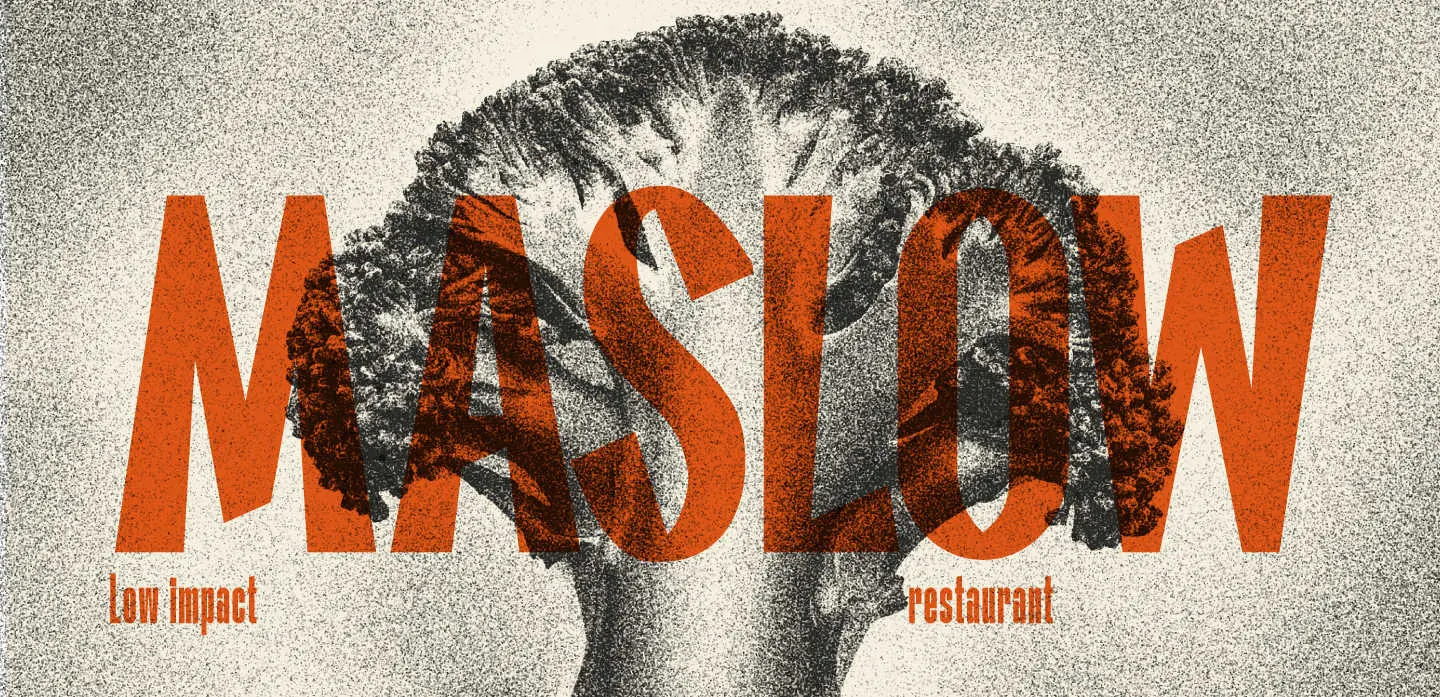
With his partners Julia Chican Vernin and Marine Ricklin, entrepreneur Mehdi Favri has opened three meat- and fish-free restaurants in Paris in just two years. Among their 40,000 monthly customers, the vast majority are not vegetarians.
A determined trio is on the verge of winning a decisive battle for vegetarian dining in Paris. Julia Chican Vernin, Marine Ricklin, and chef Mehdi Favri—the three partners behind Maslow Group, founded in 2022—have built a small empire of restaurants that serve neither meat nor fish. Following the opening of Maslow, France’s largest vegetarian restaurant, on the banks of the Seine in 2023, and Fellows, a pasta-focused concept launched near Gare de l’Est in 2024, the group has recently unveiled Maslow Temple, a 140-seat venue spread across three floors with a terrace in the heart of the Marais district.
These restaurants stand apart from the family-style vegetarian establishments that came before them, often rooted in a health-food approach. At the same time, they are more accessible than fine-dining restaurants that elevate vegetables to gastronomic art. While other venues occupy a similar niche, none have achieved the same impact: Maslow Group now welcomes more than 40,000 guests every month from all walks of life—not just vegetarians. We met them at their newest Paris address.
You opened three restaurants in two years. Did you expect success to come so quickly?
Mehdi Favri: No. The first restaurant, in particular, was a real gamble. It was oversized compared with anything that existed at the time: 120 seats indoors and another 80 on the terrace. That’s huge for a restaurant serving neither meat nor fish. But it aligned perfectly with our mission: helping as many people as possible embrace a plant-based diet.
Julia Chican Vernin: We knew we had to think big. Otherwise, we risked being seen as just another neighborhood canteen and never standing out. But the day before opening, we were terrified. Many bankers and investors told us what we were doing was absurd.
M.F.: Several restaurateur friends didn’t understand our approach either. Imagine—no quinoa and no tofu on the menu! Up until then, plant-based cooking was often associated with career changers or heavily focused on health and wellness. Many traditional chefs still viewed vegetables as little more than side dishes.
Why isn’t there a vegetarian burger on the menu?
J.C.V.: For many people, a vegetarian burger is still just a burger with something missing. We didn’t want guests to leave saying, “Something was lacking,” or “I’m still hungry.” When we hosted our first tasting dinners using Mehdi’s recipes, people weren’t talking about eating vegetarian food—they simply thought the dishes were delicious and enjoyable. In fact, according to our internal studies, vegetarians account for only around 20% of our clientele. Many guests leave our restaurants without even realizing they’ve eaten vegetarian food.
How do you convince non-vegetarians to embrace vegetables?
M.F.: We create irresistible dishes—often vegan—that act as Trojan horses. Certain techniques and ingredients are universally appealing: frying, sauces, cheese, and flaky pastry. One of our most popular dishes is inspired by Korean fried chicken, except we replace the chicken with cauliflower. Another features large breaded Portobello mushrooms served with a Shibuya-style sauce made from soy sauce and sesame oil.
Sometimes it’s simply a matter of presentation. We once served nachos topped with a meat-free lentil Bolognese. The dish only became successful when we stopped mentioning lentils in its name.
Can you maintain quality while serving 40,000 customers a month?
M.F.: We streamline every movement in the kitchen. We create videos explaining plating techniques. Most importantly, Julia and I previously worked together at FoodChéri, where we learned to produce highly detailed operational manuals that leave very little room for improvisation. Everything is measured—even down to a pinch of salt.
I’ve worked with renowned chefs such as Thierry Marx and Céline Pham, who weren’t always able to produce technical documentation with enough precision. But when you’re serving 2,500 plates of gnocchi every month, you need to know exactly how many pieces go onto each plate. Today, restaurant closures are less often caused by poor food quality than by management issues.
J.C.V.: Twenty years ago, restaurants enjoyed comfortable margins. With rising labor costs, energy prices, rents, and ingredient costs, poor management is no longer something businesses can afford.
Julia Chican Vernin, you graduated from business school and began your career at Flam’s, an all-you-can-eat flammekueche chain not particularly known for fighting food waste. How did you move from that model to a sustainability-focused restaurant group?
J.C.V.: I don’t reject that experience—it taught me a lot. When I joined Flam’s in 2005, corporate social responsibility simply wasn’t part of the conversation. It was only ten years later, while working in procurement at FoodChéri, that I began to understand the realities of the food system through visits to Rungis Market. It wasn’t pretty. I learned why French poultry could cost more than Polish poultry because of intermediaries, how salmon labeling could be misleading, and how much food ended up being thrown away. You have to get your hands dirty if you want to understand the system—and change it.
One of your goals is to reduce the carbon footprint of your restaurants. Which measures actually make a difference?
J.C.V.: Serving plant-based meals. And applying common sense.
M.F.: Everyone talks about local sourcing. The assumption is that buying local is the key to saving the planet. In reality, it’s sometimes better to buy clean than local. We carefully select responsible producers, or organic ones whenever there’s any doubt. We also have a very strict anti-waste philosophy in our kitchens. Leftover bread, for example, is toasted and turned into breadcrumbs.
Most restaurants claim they reuse leftovers and trimmings. Isn’t that standard practice nowadays?
M.F.: There’s a lot of greenwashing in this industry. In a luxury hotel, they might only keep the heart of a tomato, whereas we’ll also use the tomato water in a cocktail. We roast potato peels until they develop coffee-like aromas and then infuse them into vodka. Leek tops become either a green oil or a homemade matcha-style powder. New hires coming from prestigious kitchens are often surprised by the way we work.
Do you want to redefine the restaurant of tomorrow?
M.F.: First and foremost, we want to prove that it’s possible to operate responsibly without losing money. All of our restaurants are profitable today. That said, I don’t believe our model alone will transform the entire industry. Restaurateurs may be more inclined to look toward the UK, which is often considered a benchmark because it has far more vegetarian restaurants. I also believe public policy can play an important role. We’ve benefited from France’s Egalim law, which requires collective catering services to source more than half of their products from quality and sustainable suppliers, including at least 20% organic products.
Mehdi Favri, you oversee three different menus that are constantly evolving. Where do you find inspiration?
M.F.: I trained in hospitality, but I never actually worked in a restaurant, so I wasn’t shaped by any single culinary school of thought. Inspiration can come from another chef, a book, a documentary, a classic dish like a pithivier—or even McDonald’s Creamy Chive Deluxe sauce. We want to appeal to every social demographic.
Have you spent a lot of time thinking about pricing?
J.C.V.: Absolutely. Our goal was for guests to be able to enjoy a great meal for around €30 at Maslow and €20 at Fellows. That requires careful attention when working with expensive ingredients such as asparagus.
M.F.: It may sound harsh, but I believe there’s no longer room for chefs offering €50 or €60 menus if they appeal neither to affluent diners nor to more budget-conscious guests. If customers think it’s too expensive, then it’s too expensive. Today, what matters most isn’t an influencer post or a newspaper review—it’s your Google rating.
Will you continue opening new restaurants?
J.C.V.: We plan to open two more venues in Paris, one in the city center and one on the Left Bank. We don’t want to move too quickly; it’s important to remain humble. At Flam’s, I learned that even a successful concept can eventually fall out of fashion.